



TL;DR:
- Many common cannabis myths stem from the plant’s complexity and historical misinformation. While cannabis use disorder affects some regular users, moderate consumption, especially low-dose products, is generally safe when responsible. Understanding the differences between cannabinoids like THC and CBD helps in making informed choices about cannabis use and effects.
Common cannabis myths are widespread beliefs about marijuana that contradict current scientific evidence, and separating fact from fiction is the first step toward enjoying cannabis confidently. Whether you’re sober-curious, exploring hemp-derived THC beverages for the first time, or just tired of conflicting headlines, the noise around cannabis can feel overwhelming. Brands like 23state and research bodies like StatPearls and Scientific American have done a lot of the heavy lifting to clarify what cannabis actually does and does not do. This guide cuts through the most popular cannabis misconceptions so you can make informed, joyful choices.
1. What are the most common cannabis myths and why do they persist?
Cannabis myths persist because the plant is genuinely complex. It contains hundreds of compounds, comes in dozens of forms (flower, edibles, beverages, tinctures), and has been the subject of limited large-scale clinical trials compared to pharmaceutical drugs. Cannabis complexity and evidence gaps make it easy for oversimplified claims to fill the void. That gap is where marijuana misinformation thrives.
Social and legal history also plays a role. Decades of prohibition meant research was restricted and public messaging leaned heavily on scare tactics. Those narratives stuck around long after the science moved on.
Here are the most common cannabis myths you’ll encounter:
- Cannabis is not addictive
- Cannabis kills brain cells
- You cannot overdose on cannabis
- All cannabis products get you high
- Hemp products cannot intoxicate you
- It’s safe to drive after cannabis use once you feel fine
- Cannabis cures everything (or has zero medical value)
Pro Tip: When evaluating any cannabis claim, ask three questions: Which specific cannabinoid? At what dose? For which condition? Broad generalizations are almost always a red flag.
2. Myth: Cannabis is not addictive
Cannabis use disorder is a real, documented condition. Cannabis use disorder affects 20–30% of regular users, with risk rising sharply for those who start young or use high-potency products frequently. That figure means roughly one in four regular users develops a problematic relationship with cannabis. It does not mean casual or occasional use automatically leads to dependence, but the risk is not zero.

The myth of non-addictiveness likely grew from comparisons to substances like alcohol or opioids, where physical withdrawal symptoms are more dramatic. Cannabis withdrawal is real but tends to be psychological: irritability, sleep disruption, and appetite changes. These symptoms are less visible but still meaningful.
If you’re new to cannabis, starting with low-dose products like a microdosed THC beverage gives you far more control over your experience than high-potency flower or concentrates. That intentional approach is exactly the kind of responsible use that keeps enjoyment in the driver’s seat.
3. Myth: Cannabis kills brain cells
The claim that cannabis kills brain cells is not supported by current evidence. StatPearls and Scientific American conclude that moderate cannabis use does not cause permanent brain-cell death. This finding does not mean cannabis has zero effect on the brain. It means the dramatic “frying your brain” narrative is not what the science shows.
Research does suggest that heavy, early-onset use can affect memory and attention in adolescents, whose brains are still developing. That is a meaningful distinction. Adults using cannabis moderately, especially in low-dose beverage form, face a very different risk profile than a teenager using high-potency products daily.
The takeaway is nuance, not a green light for unlimited use. Understanding the difference between “no proven permanent cell death” and “completely harmless” is exactly the kind of clarity that helps you make smarter choices.
4. Myth: You can’t overdose fatally on cannabis
No documented deaths from a cannabis overdose exist. That part of the myth is accurate. What gets left out is that acute adverse effects are very real and can be genuinely unpleasant. High doses of THC can cause rapid heart rate, anxiety, paranoia, and significant impairment. Potency-related driving errors increase measurably with higher THC doses, which is a safety concern even if the word “overdose” does not technically apply.
Edibles and beverages are the most common culprits for overconsumption. Onset can take 30–90 minutes, and impatient first-timers often take more before the first dose kicks in. The result is an overwhelming experience that, while not fatal, is not fun.
Start low, go slow. A 2 mg or 5 mg THC beverage is a genuinely good starting point. You can always have more next time. You cannot un-drink what’s already in your glass.
5. Myth: All cannabis products get you high
Only THC (tetrahydrocannabinol) is the intoxicating cannabinoid in cannabis. CBD is mostly non-intoxicating for most people, even at high doses. This distinction matters enormously when you’re browsing a product shelf or an online store and trying to figure out what you’re actually buying.
CBD products, including oils, gummies, and beverages, do not produce the classic cannabis “high.” They may create a sense of calm or relaxation, but that is a different experience from THC intoxication. Understanding the difference between THC and CBD is the single most useful piece of knowledge for any cannabis newcomer.
CBG (cannabigerol) is another non-intoxicating cannabinoid gaining attention in wellness circles. 23state’s product line includes CBG-infused options precisely because not every moment calls for a psychoactive experience. Sometimes you just want the chill without the buzz.
6. Myth: Hemp products can’t get you high
This is one of the sneakier cannabis misconceptions out there. Hemp is legally defined by its THC content (0.3% or less by dry weight in the United States), not by any inherent inability to intoxicate. THC dose and product composition matter far more than the label “hemp” when it comes to intoxicating effects.
A hemp-derived THC beverage with 10 mg of THC per can will absolutely produce psychoactive effects. The hemp label describes the plant’s legal classification, not a promise of sobriety. This is why reading the actual cannabinoid content on any product label is non-negotiable.
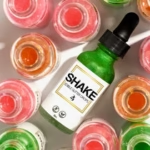
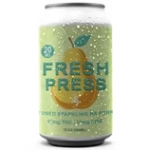
23state’s SHAKE and FRESH PRESS beverages are hemp-derived and clearly labeled with their THC content per serving. That transparency is the standard every cannabis beverage should meet. Know what’s in your drink before you open it.
7. Myth: It’s safe to drive after cannabis use once you feel fine
Feeling fine and being fine are two very different things after cannabis use. Objective driving impairment from cannabis is measurable and can last several hours, especially with edibles. Reaction time and lane-keeping are both affected, and simulator studies show these deficits persist even when users report feeling sober.
This gap between subjective and objective impairment is the most dangerous aspect of cannabis and driving. Alcohol tends to make people feel more impaired than they are. Cannabis often does the opposite. Edibles especially complicate self-assessment because the delayed onset means you might feel fine when you get behind the wheel and peak an hour into your drive.
Combining cannabis with alcohol compounds the risk significantly. The two substances interact in ways that amplify impairment beyond what either would cause alone.
Pro Tip: After consuming any THC product, wait at least four to six hours before driving. If you used edibles or a high-dose beverage, err on the side of a full night before getting behind the wheel.
8. Myth: Cannabis either cures everything or has no medical value
Both extremes are wrong. Cannabis has some medical uses supported by evidence, including specific cannabinoid products approved by the FDA for nausea, certain seizure disorders, and MS-related spasticity. These are real, meaningful applications. They are also specific, not a blanket endorsement of cannabis as a cure-all.
The “cures everything” myth is driven by enthusiastic marketing and anecdotal reports. The “no medical value” myth is a relic of prohibition-era messaging. The truth sits in the middle: medical cannabis efficacy is cannabinoid-and condition-specific, and broad claims in either direction overstate what the evidence actually shows.
For wellness-focused consumers, the science on cannabinoids for recovery is genuinely interesting and worth reading before drawing conclusions. What works for one condition at one dose may not work for another. Specificity is everything.
| Medical claim | What the evidence actually says |
|---|---|
| Cannabis cures cancer | No clinical evidence supports this claim |
| Cannabis has no medical use | FDA-approved cannabinoid drugs exist for specific conditions |
| CBD fixes anxiety for everyone | Mixed evidence; dose and individual response vary widely |
| THC beverages are medicine | Not a medical claim; recreational and wellness use differ |
Key takeaways
Debunking common cannabis myths requires separating specific cannabinoids, doses, and conditions from broad generalizations that oversimplify a genuinely complex plant.
| Point | Details |
|---|---|
| Addiction risk is real | Cannabis use disorder affects 20–30% of regular users, especially with early or high-potency use. |
| THC is the intoxicating compound | CBD and CBG do not cause a high; only THC produces psychoactive effects. |
| Hemp labels do not guarantee sobriety | Intoxication depends on THC dose, not whether a product is labeled hemp. |
| Driving impairment outlasts the feeling | Objective impairment can last hours after cannabis use, even when you feel sober. |
| Medical claims require specificity | Some cannabinoid products are FDA-approved; whole-plant cannabis lacks broad clinical approval. |
What I’ve learned from watching people discover cannabis for the first time
The myths I see trip people up most often are not the dramatic ones. Nobody really believes cannabis is lethal. The sneaky myths are the subtle ones: “I feel fine, so I’m fine to drive,” or “it’s just hemp, so it won’t do anything,” or “I’ll just take more because the first gummy isn’t hitting.”
What I’ve noticed is that curiosity is the best starting point, and low-dose beverages are the best vehicle for that curiosity. A 2 mg or 5 mg THC drink gives you a real, enjoyable experience without the unpredictability of high-potency products. It’s the difference between dipping your toes in and cannonballing into the deep end.
The cannabis-curious people who have the best experiences are the ones who read the label, start small, and give it time. They treat it the way they’d treat a new cocktail at a bar they’ve never been to: with openness and a little patience. That mindset, paired with accurate information, is what turns a nervous first try into a genuinely good time.
The myths will keep circulating because cannabis is still new to a lot of people and the research is still catching up. Your job is to stay curious, stay specific, and not let a headline or a friend’s anecdote substitute for actual facts.
— 23rd
Explore cannabis confidently with 23state
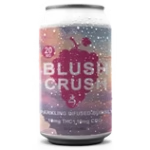
Now that you know which myths to leave behind, the fun part begins. 23state makes hemp-derived THC beverages designed for exactly this moment: the curious, the chill, and the ready-to-celebrate. SHAKE is bright and sessionable. FRESH PRESS brings a clean, crisp experience. Blush Crush is the rosy, sophisticated option for your next gathering.
Every 23state product is clearly labeled with cannabinoid content so you always know what you’re sipping. No guesswork, no surprises. Just intentional, joyful enjoyment with the transparency you deserve. Browse the full lineup at 23state.com and find the right pour for your next occasion.
FAQ
Is cannabis actually addictive?
Cannabis use disorder is real and affects roughly 20–30% of regular users, according to StatPearls. Casual or occasional use carries much lower risk, but the potential for dependence exists.
What is the difference between THC and CBD?
THC is the intoxicating cannabinoid in cannabis and produces the classic “high.” CBD is mostly non-intoxicating and does not cause psychoactive effects in most people.
Can hemp products get you high?
Yes, if they contain enough THC. Hemp labeling refers to legal classification, not intoxication potential. Always check the milligrams of THC per serving on any product label.
How long does cannabis impair your driving?
Objective driving impairment from cannabis can last several hours, even after you feel subjectively sober. Edibles carry the highest risk because their delayed onset makes self-assessment unreliable.
Does cannabis have proven medical benefits?
Specific FDA-approved cannabinoid medications exist for nausea, certain seizure disorders, and MS spasticity. Broad claims that cannabis cures or treats conditions generally overstate what current clinical evidence supports.