


TL;DR:
- CBD:THC ratios indicate the relative amounts but total milligrams influence effects significantly.
- Recent studies show CBD can increase THC levels and impairment, not always mitigate effects.
- Formulation and delivery method greatly impact onset, intensity, and user experience.
Most people assume that adding CBD to a THC drink automatically mellows the ride. It’s a tidy, reassuring idea, and it’s also not quite right. Research now shows the relationship between these two cannabinoids is far more nuanced, and in some cases, CBD can actually intensify THC’s effects rather than soften them. If you’re sipping infused beverages for wellness, relaxation, or a little recreational sparkle, understanding CBD:THC ratios is the difference between an intentional experience and an unexpected one. This guide breaks down what ratios actually mean, how formulation and delivery technology shape your results, and how to choose the drink that fits your goals.
Table of Contents
- What does CBD:THC ratio mean in drinks?
- How does the CBD:THC ratio impact effects and impairment?
- Why drink formulation and delivery method matter
- Factors to consider when choosing a CBD THC ratio drink
- A smarter approach to CBD THC ratio drinks
- Ready to explore CBD THC drink options?
- Frequently asked questions
Key Takeaways
| Point | Details |
|---|---|
| Ratios aren’t everything | Your experience depends on ratio, dosage, formulation, and added ingredients. |
| CBD can intensify THC | In some CBD:THC drinks, CBD increases THC’s effects rather than reducing them. |
| Formulation alters onset | Delivery technologies like nanoemulsions can make THC effects hit faster and harder. |
| Choose thoughtfully | Start low and read all labels, especially for co-ingredients like caffeine. |
What does CBD:THC ratio mean in drinks?
To truly understand what these beverages do, let’s break down the numbers and terminology behind their ratios.
A CBD:THC ratio simply describes the comparative amount of CBD to THC in each serving. A 1:1 drink contains equal parts CBD and THC. A 5:1 drink has five times more CBD than THC. A 1:5 flips that, delivering far more THC relative to CBD. Understanding cannabinoid ratios explained is your first step toward choosing the right sip.
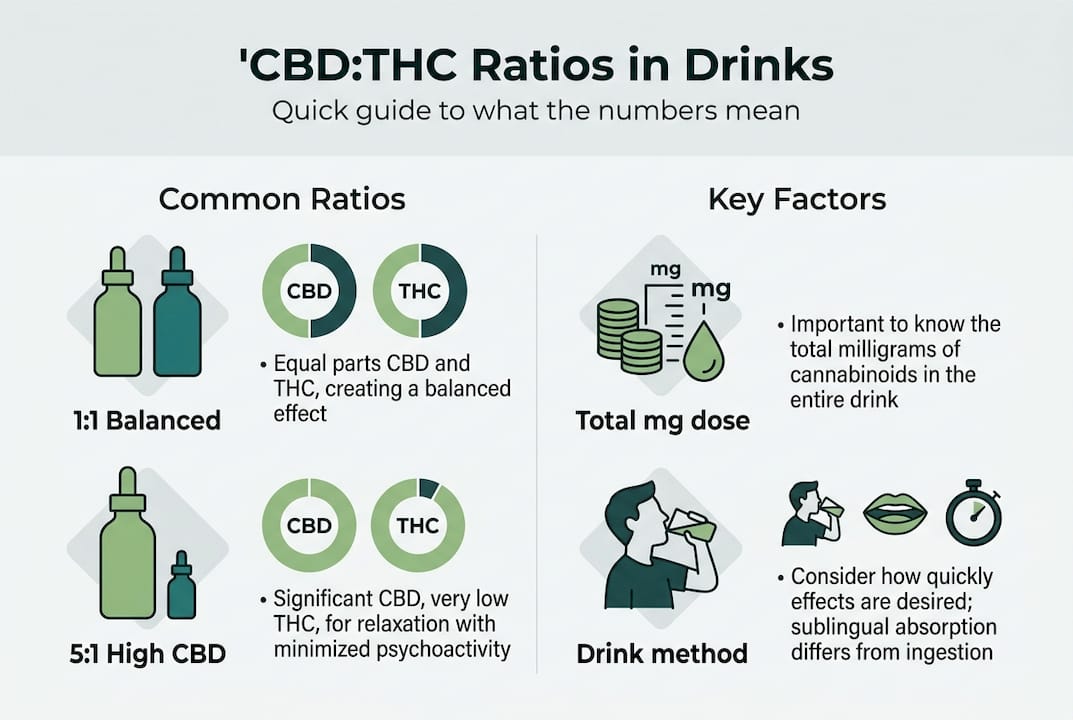
But here’s where many people get tripped up: the ratio alone tells you very little without knowing the total milligrams per serving. A 1:1 drink with 2 mg of each cannabinoid behaves very differently from a 1:1 drink with 20 mg of each. More milligrams mean stronger effects, regardless of how balanced the ratio looks on the label. Knowing the THC vs. CBD differences helps put those numbers in context.
Beyond milligrams and ratios, other variables shift the picture considerably. Added caffeine, adaptogens, and even the drink’s delivery technology (more on that below) all influence how the cannabinoids interact in your body. According to research on oral cannabinoid delivery, the experience depends on total mg per serving, delivery method, formulation tech like nanoemulsions, and co-ingredients like caffeine, not just the stated ratio.
Sample CBD:THC ratio comparison
| Ratio (CBD:THC) | Typical experience | Best for |
|---|---|---|
| 10:1 | Minimal psychoactivity, calming | Wellness, daytime use |
| 5:1 | Mild lift, relaxed focus | Light recreation, stress relief |
| 1:1 | Balanced, moderate effect | Social settings, mood support |
| 1:5 | Stronger psychoactive effect | Experienced users, recreation |
Key questions to ask when evaluating a CBD:THC drink:
- What is the total mg of THC and CBD per serving?
- What delivery system does the drink use (oil, nanoemulsion, powder)?
- Does it contain caffeine, adaptogens, or other active ingredients?
- Is the ratio listed per serving or per container?
- Does the brand provide third-party lab testing?
How does the CBD:THC ratio impact effects and impairment?
Knowing the numbers is just the beginning. Understanding their impact requires a closer look at the science.
The popular belief is that CBD acts as a brake pedal on THC, smoothing out any rough edges. That belief has some truth to it in certain contexts, but it’s far from a universal rule. In fact, the science points in a more surprising direction for drinks specifically.
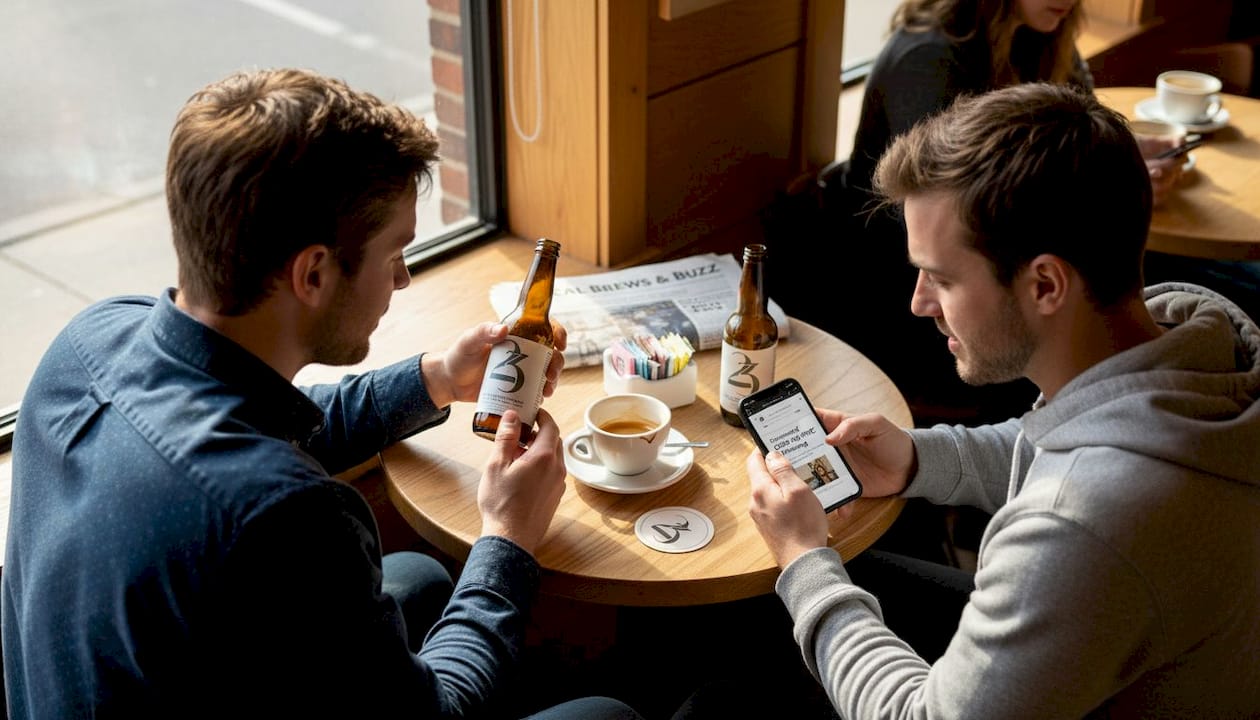
In a rigorous double-blind crossover study, oral CBD was shown to change the pharmacokinetics of THC in ways that can actually intensify impairment rather than reduce it. CBD added to THC increased plasma THC levels significantly (p=0.004), leading to stronger subjective highs and greater measured impairment. This is the opposite of what most marketing copy suggests.
What happens as you shift the balance?
- More THC, less CBD: Stronger psychoactive effects, faster onset of impairment, more intense euphoria.
- Equal parts (1:1): A blended experience where both compounds are present, but outcomes remain unpredictable without knowing total mg and formulation.
- More CBD, less THC: Generally milder psychoactivity, though CBD can still raise THC bioavailability in certain formulations.
- High CBD alone: Minimal to no intoxication, but potential wellness benefits like calm focus and physical ease.
“Don’t assume CBD will reliably ‘balance out’ THC in a drink. The evidence shows that oral co-administration can increase THC exposure and lead to more impairment, not less. Treat every new product as its own experiment and start low.”
For a fuller picture of what to expect, exploring how THC drinks make you feel gives helpful context. And if you’re curious about the broader upside, reading about THC drink benefits rounds out the picture nicely.
The takeaway: impairment is not solely predictable by ratio. Context, total dose, and formulation all play a real role.
Why drink formulation and delivery method matter
Formulation can alter how ratios work, and the same drink on paper can feel very different in practice.
Imagine two drinks with identical 1:1 ratios at 5 mg each of THC and CBD. One uses a traditional oil-based infusion. The other uses a nanoemulsion, which breaks cannabinoid particles into ultra-tiny droplets for faster, more efficient absorption. These two drinks can feel entirely different even though the label looks the same.
Research confirms that delivery method significantly affects onset speed and total exposure for oral cannabinoid products. Nanoemulsions and self-nanoemulsifying systems tend to hit harder and faster than standard oil-based drinks. For wellness cannabis drinks, this distinction matters a lot, especially for anyone managing a specific dose or timing their experience around a social event or bedtime wind-down.
Delivery system comparison
| Delivery type | Typical onset | Peak effect timing | Notes |
|---|---|---|---|
| Oil-based infusion | 45 to 90 minutes | 90 to 120 minutes | Slower, gentler absorption |
| Nanoemulsion | 10 to 30 minutes | 45 to 60 minutes | Faster, stronger bioavailability |
| Water-soluble powder | 15 to 45 minutes | 60 to 90 minutes | Consistent, mixable format |
Understanding THC beverage formulations can help you match the right product to your lifestyle and timing needs.
Pro Tip: When comparing two drinks with the same ratio, check the product details for words like “nanoemulsion,” “water-soluble,” or “fast-acting.” These signal a delivery system that may hit faster and stronger than you expect, especially if you’re newer to infused beverages.
Factors to consider when choosing a CBD THC ratio drink
Now that you understand the science, here’s how to make smart, personalized decisions with your drink choices.
Choosing the right CBD:THC drink isn’t just about picking a ratio that sounds appealing. It’s about reading the full picture, including your personal goals, tolerance, and the drink’s complete ingredient list. Because as research reinforces, the experience is shaped by total mg, delivery method, formulation, and co-ingredients working together.
What to evaluate before you buy:
- Intended effect: Are you looking for a calming self-care ritual, a social buzz, or something in between? High-CBD, low-THC drinks lean toward wellness. Higher THC drinks are more recreational.
- Your personal tolerance: If you’re newer to THC, even a 5:1 CBD:THC drink at 10 mg THC per can is a strong starting point. Tolerance varies widely between individuals.
- Added ingredients: Caffeine, ashwagandha, l-theanine, and other active compounds can shift your experience. Caffeine in particular has been shown to amplify the effects of THC combinations.
- Total cannabinoids per serving: A 10:1 ratio sounds very CBD-forward, but if it contains 50 mg CBD and 5 mg THC, that 5 mg THC is still a meaningful dose for many people.
- Lab testing and transparency: Reputable brands provide certificates of analysis so you know exactly what’s in the can.
- Delivery technology: Fast-acting formats call for extra caution, especially if you’re still learning your sweet spot. For guidance on adding cannabinoids to other beverages safely, see the tips on mixing THC tinctures safely.
Pro Tip: Start with a low total THC dose, ideally 2 to 5 mg, in a balanced or high-CBD drink. Wait at least 60 to 90 minutes before considering a second serving. Your body and the formulation both need time to show their hand.
A smarter approach to CBD THC ratio drinks
Putting all the information together, here’s a perspective that cuts through misleading marketing.
We’ve spent years watching people pick CBD:THC drinks based almost entirely on what sounds safe or balanced. A high-CBD ratio feels reassuring. But the real world isn’t always that tidy. Your body chemistry, what you ate, your stress level that day, and the specific formulation in that can all affect what happens next.
The “CBD calms THC” narrative is a marketing-friendly simplification, and the science increasingly pushes back on it for drinks specifically. What we’d rather see is curious, informed sippers who actually track their experience. Notice the onset time. Notice the intensity. Notice how long it lasts. That personal data is more useful than any ratio printed on a label.
Head to our THC drinks education hub to keep building that knowledge base. Responsible enjoyment comes from curiosity and self-awareness, not blind trust in a number.
Ready to explore CBD THC drink options?
When you’re ready to try options that fit your needs, here’s where to start.
You’ve got the knowledge. Now comes the fun part: finding a drink that actually fits your lifestyle, your taste, and your wellness goals.
At 23State, you can shop curated CBD THC drinks organized by effect profile, ratio, and formulation style. Whether you’re easing in with a high-CBD, low-THC option or you’re ready to explore something bolder, the selection is designed for intentional sipping. Browse by what you’re after, and tap into the educational resources alongside each product to make confident, informed choices. Your perfect pour is out there.
Frequently asked questions
Does CBD always reduce the effects of THC in drinks?
No. Recent studies show that oral CBD can actually intensify THC’s effects and increase impairment in certain drink combinations, making it important to evaluate every product individually.
What ratio of CBD to THC is best for beginners?
Most experts recommend starting with a balanced 1:1 or a high-CBD, lower-THC option at a low total dose. Research confirms that formulation matters as much as dosage and ratio, so start low and go slow regardless of the label.
Can the effects of CBD THC ratio drinks change with added ingredients like caffeine?
Yes. Studies show that CBD, THC, and caffeine combined led to stronger subjective effects and greater impairment than THC alone, so always check the full ingredient list before sipping.
How fast do CBD THC drinks take effect?
Onset can range from 10 minutes to over an hour. Delivery system impacts onset speed and peak exposure significantly, with nanoemulsion-based drinks acting faster than traditional oil-infused options.