







You’ve probably heard conflicting claims about cannabinoids: some people swear by CBD for anxiety relief, others rave about THC’s recreational effects, and wellness influencers tout various hemp products as cure-alls. The truth is, cannabinoid science is more nuanced than marketing slogans suggest. Understanding how these compounds interact with your body’s endocannabinoid system helps you make smarter decisions about wellness products and recreational use. This guide breaks down the biology behind cannabinoid receptors, explains why different cannabinoids produce distinct effects, and shows you how to navigate the hemp product market safely in 2026.
Table of Contents
- What Is The Endocannabinoid System And Why Does It Matter?
- How Cannabinoids Interact With Receptors: THC, CBD, And Others
- The Health Implications Of Cannabinoid Receptor Dysregulation
- Choosing And Using Cannabinoid Products Safely In 2026
- Explore Trusted Cannabinoid Products And Guidance
- FAQ
Key takeaways
| Point | Details |
|---|---|
| Endocannabinoid system regulates health | Your ECS controls appetite, pain, mood, and immune function through CB1 and CB2 receptors distributed throughout your body. |
| Cannabinoids interact differently | THC binds directly to CB1 receptors causing psychoactive effects, while CBD modulates the system indirectly without strong intoxication. |
| Receptor imbalances link to disease | Dysregulation of CB1R and CB2R relates to metabolic disorders, cardiovascular problems, and neurological conditions like Alzheimer’s. |
| Unregulated products pose risks | Many cannabis products lack quality control, potentially exposing consumers to contaminants or inaccurate dosing. |
| Knowledge enables safer choices | Understanding cannabinoid science helps you evaluate product claims, recognize red flags, and select effective, compliant options. |
What is the endocannabinoid system and why does it matter?
Your body produces its own cannabis-like molecules. The endocannabinoid system (ECS) is a complex cell-signaling network discovered in the early 1990s that regulates critical bodily functions. Think of it as your body’s internal balancing act, constantly adjusting processes to maintain homeostasis. This system operates whether you consume cannabis or not, using naturally produced endocannabinoids to fine-tune everything from your appetite to your immune response.
The ECS works primarily through two receptor types: CB1 and CB2. CB1 receptors concentrate heavily in your brain and central nervous system, particularly in areas controlling memory, motor coordination, pain perception, and emotional processing. When activated, these receptors influence neurotransmitter release, affecting how your brain cells communicate. CB2 receptors populate your immune system, peripheral tissues, and organs, playing a crucial role in inflammation control and immune response modulation.
This receptor network maintains homeostasis by responding to internal signals and external cannabinoids. When you experience stress, injury, or imbalance, your ECS activates to restore equilibrium. The system influences multiple bodily functions:
- Appetite regulation and metabolism
- Pain sensation and inflammation response
- Mood stability and stress management
- Memory formation and cognitive function
- Immune system activity
- Sleep-wake cycles
- Reproductive system function
Pro Tip: Your endocannabinoid tone (the baseline activity of your ECS) varies based on genetics, diet, stress levels, and lifestyle factors. Both deficiency and excessive activation can disrupt health, which is why understanding your body’s response to cannabinoids matters more than following generic dosing recommendations.
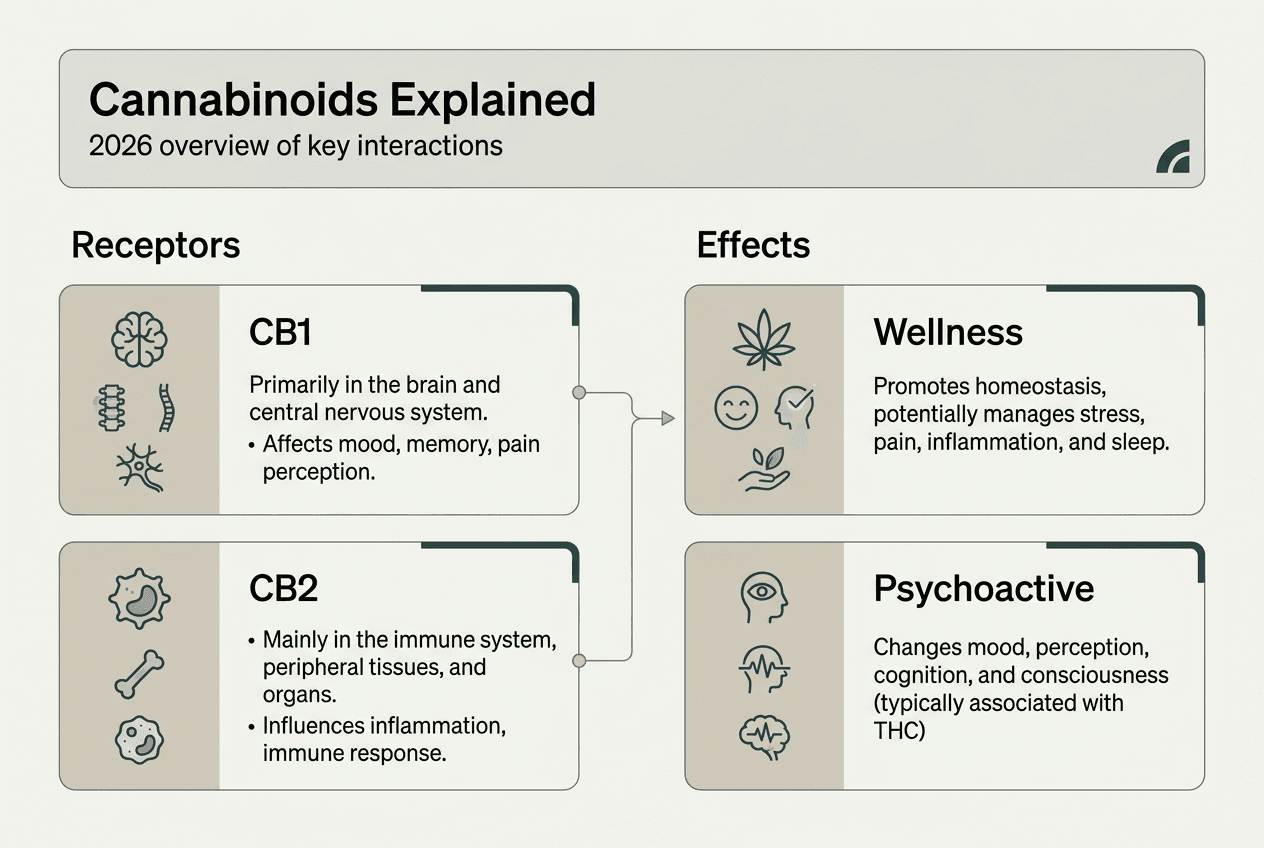
The ECS doesn’t work in isolation. It interacts with other bodily systems, creating a web of biological communication that scientists are still mapping. Dysregulation of CB1R and CB2R has been linked to metabolic, cardiovascular, and neurological disorders, highlighting how crucial proper ECS function is for overall health. When you consume cannabinoids from hemp or cannabis plants, you’re essentially introducing external molecules that hijack this existing system, which explains both the therapeutic potential and the risks of cannabinoid use.
How cannabinoids interact with receptors: THC, CBD, and others
Not all cannabinoids affect your body the same way. THC (tetrahydrocannabinol) acts as a partial agonist at CB1 receptors, meaning it binds directly to these receptors and activates them, though not as strongly as your body’s natural endocannabinoids. This binding primarily occurs in brain regions controlling pleasure, memory, thinking, concentration, and coordination, producing the characteristic psychoactive effects associated with cannabis use. The intensity of these effects depends on THC concentration, consumption method, and your individual ECS sensitivity.

CBD (cannabidiol) operates through a completely different mechanism. It has low affinity for both CB1 and CB2 receptors, rarely binding directly to them. Instead, CBD modulates the ECS indirectly by preventing the breakdown of your natural endocannabinoids, effectively boosting their levels and duration of action. CBD also interacts with serotonin receptors, vanilloid receptors, and other non-cannabinoid receptor systems, explaining its diverse effects without causing significant intoxication.
Other cannabinoids like CBG (cannabigerol) and CBC (cannabichromene) show promise but remain less understood. CBG appears to interact with both CB1 and CB2 receptors with varying affinity, while CBC seems to work primarily through non-cannabinoid pathways. Research into these minor cannabinoids is expanding rapidly as scientists recognize their potential therapeutic applications.
| Cannabinoid | Receptor Interaction | Primary Effects | Legal Status (2026) |
|---|---|---|---|
| THC | Direct CB1 agonist | Psychoactive, pain relief, appetite stimulation | Federally restricted, state-dependent |
| CBD | Indirect ECS modulation | Non-intoxicating, anxiety reduction, anti-inflammatory | Federally legal (hemp-derived) |
| CBG | CB1/CB2 interaction | Non-intoxicating, potential neuroprotective | Federally legal (hemp-derived) |
| CBC | Non-cannabinoid pathways | Non-intoxicating, anti-inflammatory | Federally legal (hemp-derived) |
Pro Tip: Cannabinoid ratios matter significantly more than most people realize. A product with balanced THC:CBD ratios produces markedly different effects than high-THC or CBD-only formulations. The entourage effect, where multiple cannabinoids and terpenes work synergistically, can enhance benefits or reduce unwanted side effects, making whole-plant extracts potentially more effective than isolated compounds for some users.
The market flood of cannabinoid products creates serious safety concerns. Unregulated promotion of cannabis-based products without sufficient evidence risks consumer safety, as many manufacturers make therapeutic claims without clinical validation. Products may contain inaccurate cannabinoid concentrations, contaminants like pesticides or heavy metals, or even synthetic cannabinoids masquerading as natural compounds. Understanding [cannabis product safety standards](https://23state.com/blogs/education/cannabis product safety standards us) and [cannabis compliance laws and risks](https://23state.com/blogs/education/cannabis compliance explained laws risks) helps you navigate this complex landscape and avoid dangerous products.
The health implications of cannabinoid receptor dysregulation
Your ECS doesn’t always function optimally. When CB1 or CB2 receptor activity becomes imbalanced through genetic factors, chronic stress, poor diet, or excessive cannabinoid exposure, health consequences can emerge. Dysregulation of CB1R and CB2R relates to metabolic, cardiovascular, and neurological diseases, creating a compelling case for maintaining healthy endocannabinoid tone.
Scientific research has connected ECS dysfunction to specific disease states. Overactive CB1 signaling in peripheral tissues contributes to obesity and metabolic syndrome by promoting fat storage and reducing energy expenditure. Conversely, reduced CB1 activity in certain brain regions may worsen depression and anxiety disorders. CB2 receptor dysfunction impairs immune regulation, potentially worsening inflammatory conditions like arthritis, inflammatory bowel disease, and autoimmune disorders.
| Disease Category | Associated Conditions | ECS Role | Symptoms |
|---|---|---|---|
| Metabolic Disorders | Obesity, type 2 diabetes, metabolic syndrome | Overactive CB1 in peripheral tissues | Weight gain, insulin resistance, inflammation |
| Cardiovascular Disease | Heart failure, atherosclerosis | CB1/CB2 imbalance affecting heart tissue | Reduced cardiac function, arterial plaque |
| Neurological Conditions | Alzheimer’s, Parkinson’s, MS, epilepsy | Altered CB1 signaling in brain regions | Cognitive decline, motor dysfunction, seizures |
| Inflammatory Disorders | Arthritis, IBD, autoimmune conditions | Impaired CB2 immune modulation | Chronic inflammation, tissue damage |
These findings suggest cannabinoid-based therapies might help restore balance, but the reality is more complex. While some patients experience symptom relief from medical cannabis or hemp-derived products, individual responses vary dramatically. Factors influencing therapeutic outcomes include:
- Genetic variations in cannabinoid receptor genes
- Baseline endocannabinoid tone and enzyme activity
- Disease stage and severity
- Cannabinoid dosage, ratio, and delivery method
- Concurrent medications and lifestyle factors
- Duration and consistency of cannabinoid use
The therapeutic window for cannabinoids can be narrow. Too little provides no benefit, while excessive use may worsen symptoms or create new problems like tolerance, dependence, or cognitive impairment. This is why blanket recommendations about cannabinoid use for specific conditions often fail. What works for one person’s chronic pain might be ineffective or problematic for another with the same diagnosis.
Understanding the [cannabis regulatory overview](https://23state.com/blogs/education/cannabis regulatory overview us guide) helps you recognize which products have legitimate therapeutic potential versus those making unfounded claims. Consulting healthcare professionals familiar with cannabinoid medicine, starting with low doses, and monitoring your response carefully creates a safer approach than self-medicating based on internet advice. Resources like the [safe cannabis dosages guide](https://23state.com/blogs/education/guide to safe cannabis dosages adults) provide evidence-based starting points for adults exploring cannabinoid wellness products.
Choosing and using cannabinoid products safely in 2026
Navigating the cannabinoid product market requires vigilance and knowledge. Follow this step-by-step approach to minimize risks and maximize potential benefits:
- Research the product category and verify it’s legal in your jurisdiction, checking both federal hemp regulations and state-specific cannabis laws.
- Select products only from licensed dispensaries or retailers who provide transparent sourcing and manufacturing information.
- Request and review third-party lab certificates of analysis (COAs) confirming cannabinoid potency, terpene profiles, and absence of contaminants.
- Start with the lowest effective dose, typically 2.5 to 5 mg of THC or 10 to 20 mg of CBD for beginners, and increase gradually over weeks.
- Track your response in a journal, noting effects, timing, dosage, and any side effects to identify your optimal regimen.
- Consult healthcare providers before using cannabinoids if you take medications, have chronic conditions, or are pregnant or breastfeeding.
Pro Tip: Most people overlook reading product certificates of analysis thoroughly, missing critical information about potency accuracy and contamination. A quality COA should test for cannabinoid content, residual solvents, pesticides, heavy metals, and microbial contaminants. If a manufacturer won’t provide current lab results, walk away.
Third-party testing separates legitimate products from dangerous imposters. Independent laboratories verify that products contain what labels claim and remain free from harmful substances. Key elements to check in lab reports include:
- Cannabinoid potency matching label claims within 10 percent
- Absence of pesticides, with all compounds below action limits
- Heavy metal levels (lead, arsenic, mercury, cadmium) below safety thresholds
- Microbial contamination (mold, bacteria, yeast) within acceptable ranges
- Residual solvent levels below regulatory limits for extraction products
- Terpene profiles for full-spectrum or broad-spectrum products
Unregulated cannabis products pose risks due to lack of efficacy, safety, and quality control, making verification essential. The 2026 market includes both compliant hemp-derived products and illegal cannabis items marketed deceptively. Understanding [cannabis product safety standards](https://23state.com/blogs/education/cannabis product safety standards us) helps you distinguish between them.
Dosage guidance varies significantly by product type, consumption method, and individual factors. Inhalation (smoking or vaping) produces effects within minutes but lasts only 2 to 4 hours. Edibles take 30 minutes to 2 hours to work but provide effects lasting 6 to 8 hours or longer. Sublingual tinctures fall between these extremes, offering relatively quick onset with moderate duration. Your body weight, metabolism, ECS sensitivity, and tolerance all influence optimal dosing, which is why standardized recommendations often fail.
Staying informed about evolving cannabis regulations protects you from legal problems and helps you identify compliant products. The 2026 regulatory landscape continues shifting as states modify medical and recreational programs while federal agencies refine hemp product oversight. Resources explaining [safe cannabis dosages](https://23state.com/blogs/education/guide to safe cannabis dosages adults) and [cannabis compliance](https://23state.com/blogs/education/cannabis compliance explained laws risks) keep you current on best practices and legal requirements, reducing your risk of purchasing unsafe or illegal products.
Explore trusted cannabinoid products and guidance
Applying cannabinoid science to real-world wellness decisions requires reliable sources and quality products. 23rd State offers vetted, lab-tested cannabinoid products that meet rigorous safety standards, helping you confidently explore hemp-derived options for wellness and recreation. Every product undergoes third-party testing to verify potency and purity, eliminating guesswork about what you’re consuming.

Beyond products, 23rd State provides educational resources covering compliance, dosage, and legal considerations that empower informed decision-making. Whether you’re new to cannabinoids or refining your wellness routine, access to current information about [product safety standards](https://23state.com/blogs/education/cannabis product safety standards us) and regulatory requirements helps you navigate this complex market successfully. Explore trusted cannabinoid products and guidance to apply the science you’ve learned and discover options aligned with your wellness goals.
FAQ
How do cannabinoids produce both wellness and psychoactive effects?
THC binds primarily to CB1 receptors concentrated in brain regions controlling mood, memory, and perception, producing psychoactive effects alongside potential therapeutic benefits like pain relief. CBD modulates the endocannabinoid system indirectly without strong CB1 activation, providing wellness benefits such as anxiety reduction and anti-inflammatory effects without significant intoxication. Different cannabinoids affect receptors variably, explaining the diverse effects you experience from various cannabis and hemp products.
Can using cannabinoids help with neurological disorders?
Some research suggests cannabinoid modulation may alleviate symptoms or slow progression of conditions like Alzheimer’s, Parkinson’s, and epilepsy, as receptor dysregulation links to these neurological disorders. However, clinical evidence remains limited for most conditions, and individual responses vary significantly based on genetics, disease stage, and cannabinoid formulation. Always consult healthcare professionals experienced in cannabinoid medicine before using these products to manage neurological symptoms, as they can provide personalized guidance and monitor for potential interactions or side effects.
What should I look for to ensure a cannabinoid product is safe?
Check for third-party lab results verifying cannabinoid potency matches label claims and confirming absence of contaminants like pesticides, heavy metals, and microbial contamination. Follow dosage guidelines appropriate for your experience level and consumption method, starting low and increasing gradually while monitoring effects. Buy exclusively from licensed, compliant sellers who provide transparent sourcing information and current certificates of analysis, as outlined in [cannabis product safety standards](https://23state.com/blogs/education/cannabis product safety standards us).
Why do different people respond so differently to the same cannabinoid product?
Genetic variations in cannabinoid receptor genes, endocannabinoid-metabolizing enzymes, and related pathways create significant individual differences in ECS function and cannabinoid sensitivity. Your baseline endocannabinoid tone, influenced by diet, stress, sleep, exercise, and prior cannabinoid exposure, also affects how you respond to external cannabinoids. Body weight, metabolism, concurrent medications, and even gut microbiome composition contribute to this variability, explaining why personalized approaches work better than one-size-fits-all dosing recommendations.