


Finding reliable hemp products in Texas or South Carolina has never been more complicated. Recent changes to federal law mean the definition of legal hemp now includes all forms of THC, with a strict limit of 0.4 mg total THC per container nationwide. These updates close loopholes that previously allowed psychoactive cannabinoids like delta-8 and THCA, directly affecting which products you can safely and legally buy. Get clear on what counts as legal hemp so you can protect your health and avoid surprise compliance issues.
Table of Contents
- Defining Hemp And Its Legal Distinctions
- Federal Hemp Laws In 2025 Explained
- Texas Rules For Hemp-Derived Products
- South Carolina Hemp Laws And Pending Changes
- Major Restrictions, Product Bans, And Enforcement Trends
- Risks For Buyers And Businesses In 2025
Key Takeaways
| Point | Details |
|---|---|
| New Federal THC Regulations | Starting November 2026, a total THC limit of 0.4 mg per container will be enforced, impacting hemp product legality. |
| Impact on State Regulations | States like Texas and South Carolina are adjusting their hemp laws to align with or anticipate federal restrictions, creating a complex regulatory landscape. |
| Consumer Vigilance Required | Consumers should verify total THC content and compliance documentation for hemp products to avoid purchasing illegal items. |
| Business Adaptation Necessary | Hemp businesses must reformulate products and ensure compliance with new regulations to avoid losses and potential closure in the evolving market. |
Defining Hemp and Its Legal Distinctions
Before 2018, hemp and marijuana were legally indistinguishable under federal law. Both were classified as controlled substances, making cultivation and possession criminal offenses. The Agriculture Improvement Act of 2018, commonly called the 2018 Farm Bill, changed everything by establishing a specific legal definition: hemp is cannabis containing no more than 0.3% delta-9 THC by dry weight. This single distinction separated hemp from marijuana in the eyes of federal law, opening the door to a legitimate agricultural industry and consumer market across the United States.
That definition worked for several years, but it had a critical gap. The 2018 Farm Bill only measured delta-9 THC, leaving other intoxicating cannabinoids like delta-8, delta-10, and THCA in a legal gray area. Manufacturers exploited this loophole by creating hemp-derived products with minimal delta-9 THC but significant amounts of these other psychoactive compounds. Consumers could legally purchase these products in states where cannabis remained restricted, and the market exploded. However, Congress enacted new provisions in 2025 that fundamentally reshaped the industry. The updated definition now addresses total THC content—all tetrahydrocannabinols combined—with a strict limit of 0.4 mg THC per container. This change effectively closes the loopholes that allowed delta-8 and THCA products to flourish, redefining what legally qualifies as hemp and creating significant market implications for Texas, South Carolina, and the rest of the nation.
Understanding this distinction matters for your purchasing decisions. Products exceeding 0.4 mg total THC per container or containing synthetic cannabinoids are no longer classified as hemp under federal law. If you’ve purchased hemp-derived products in the past, including hemp-infused beverages and other wellness options, the 2025 reclassification means the market is recalibrating. Some products you could buy yesterday may no longer be legally available today. This isn’t about marijuana becoming legal in your state—it’s about the federal government tightening the definition of what counts as legal hemp to prevent intoxicating products from hiding behind the hemp label.
Pro tip: When shopping for hemp products in 2025, verify that items display third-party lab testing results showing total THC content below 0.4 mg per container, and check whether your state has adopted the new federal definition or maintains its own regulations.
Federal Hemp Laws in 2025 Explained
The FY2026 Agriculture Appropriations Act, signed in November 2025, fundamentally transformed how hemp is regulated at the federal level. The most significant change involves a complete redefinition of what qualifies as legal hemp. Instead of focusing solely on delta-9 THC content like the 2018 Farm Bill did, the new law takes a broader approach by measuring total THC content across all cannabinoids. This includes delta-9 THC, THCA, delta-8, delta-10, and any other tetrahydrocannabinol present in the product. The law establishes two key limits: products cannot exceed 0.3% total THC on a dry weight basis, and individual containers are capped at 0.4 mg total THC. These restrictions take effect in November 2026, giving the industry time to adjust but creating immediate uncertainty for manufacturers and retailers.
What makes these changes so significant is what they target. The 2018 Farm Bill’s narrow definition created what many call the “hemp loophole”—a legal gray area where manufacturers could produce intoxicating products like delta-8 and delta-10 THC with minimal regulatory oversight. These products flourished because they technically complied with federal hemp laws while delivering psychoactive effects comparable to traditional cannabis. The 2025 amendments close this loophole entirely. New federal restrictions on hemp and derived products also explicitly ban synthetic or chemically converted cannabinoids, meaning delta-8 THC—even when derived from hemp—is no longer legal if it’s been chemically converted. The FDA will issue further guidance to clarify implementation, but the intent is clear: the federal government is tightening the screws on products designed to circumvent cannabis prohibition.
For consumers and businesses, this creates a watershed moment. If you currently use or sell hemp-derived THC products, your options are changing. Products that were perfectly legal yesterday may become illegal in November 2026. The market will recalibrate around products that remain compliant, and businesses will need to pivot quickly. Some companies are already reformulating their offerings or exiting the market entirely. This isn’t just regulatory nitpicking—it represents a fundamental shift in federal policy that affects what you can legally purchase, how retailers stock shelves, and what manufacturers choose to produce going forward.
Pro tip: Before purchasing any hemp-derived product, ask retailers for documentation showing total THC content testing and ask whether they plan to reformulate before November 2026, so you understand exactly what compliance means for the products you use.
Texas Rules for Hemp-Derived Products
Texas takes a different approach to hemp regulation than many states. Rather than outright prohibition, Texas has chosen to regulate hemp-derived products while protecting specific populations. In 2025, Texas Governor Greg Abbott issued Executive Order GA-56, which focuses heavily on protecting children from intoxicating hemp products. The order emphasizes restricting access by minors and enforcing safeguards around products with psychoactive properties. This came after the Texas Legislature failed to pass a complete ban on intoxicating hemp products, signaling that Texas prefers a regulatory framework over total prohibition. The state recognizes the economic importance of the hemp industry while simultaneously addressing public health concerns about product accessibility.
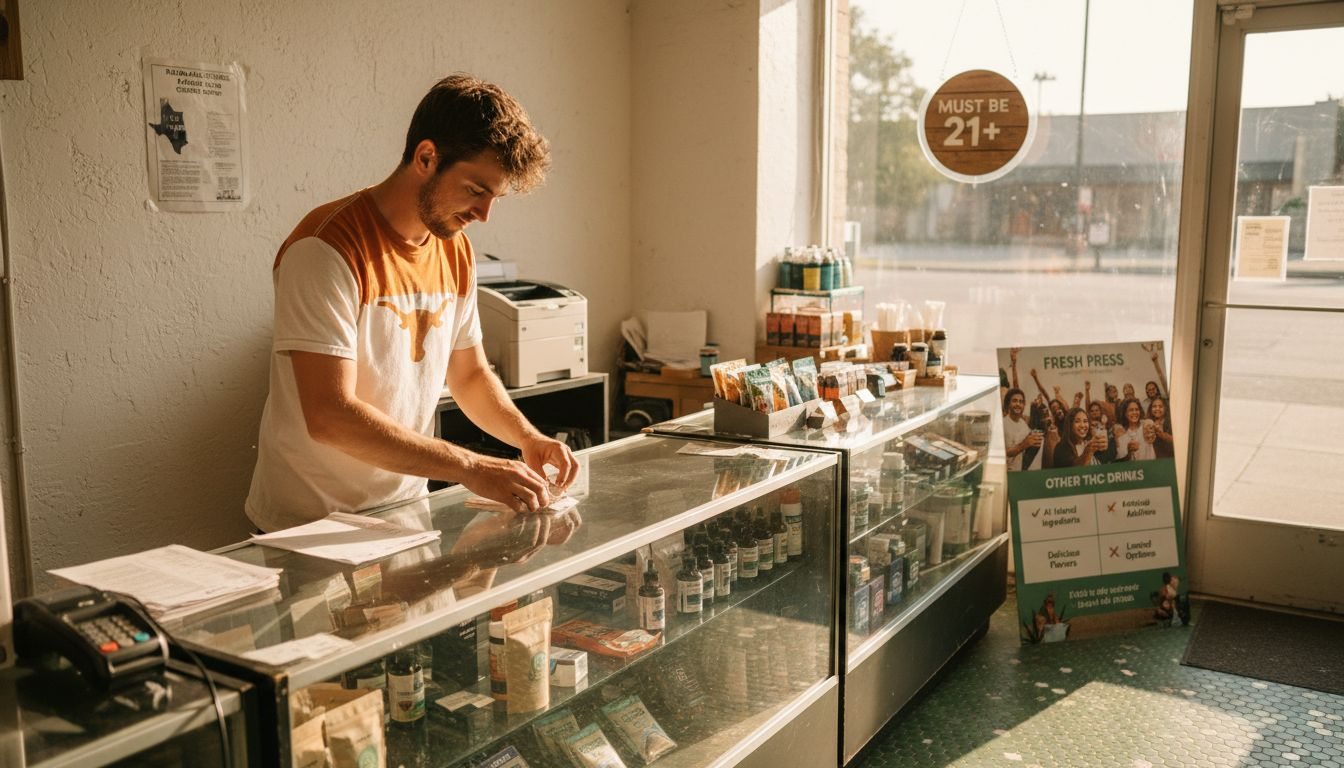
The most practical rule for consumers to understand is the age restriction. The Texas Alcoholic Beverage Commission (TABC) implemented regulations requiring that consumable hemp products be restricted to purchasers aged 21 and older, with mandatory ID verification at the point of sale. This mirrors alcohol regulations and reflects Texas’s effort to balance public health protection with industry continuation. Texas state rules attempt to maintain consistency with how the state regulates other potentially intoxicating substances, creating a framework that feels familiar to retailers and consumers already accustomed to age-gated products. However, this state-level approach now faces complications from the new federal restrictions taking effect in November 2026. Texas cannot supersede federal law, meaning that when the 0.4 mg total THC per container limit becomes federal policy, Texas retailers will need to comply regardless of state preferences.
The tension between Texas regulations and federal law creates real uncertainty for the hemp industry operating in the state. Products currently legal under Texas rules may become federally illegal in November 2026. Texas regulators are aware of this collision and are preparing for market disruption. Some retailers are already making decisions about product reformulation or discontinuation. If you purchase hemp-derived products in Texas, understanding both state age restrictions and the impending federal changes helps you make informed decisions. The regulatory landscape is shifting beneath the market, and companies are scrambling to adapt. Texas’s current framework provides some protection and structure, but it functions as a bridge regulation destined for major changes within months.
Pro tip: In Texas, always bring a valid ID when purchasing hemp-derived products, and ask retailers whether their current inventory will comply with the November 2026 federal restrictions to understand the stability of products you regularly use.
South Carolina Hemp Laws and Pending Changes
South Carolina is taking a distinctly different regulatory path than Texas. Rather than waiting for federal enforcement, the state legislature has moved aggressively to preempt the 2025 federal restrictions by implementing its own comprehensive hemp framework. In 2025, South Carolina introduced legislation that creates a licensing system for manufacturers, distributors, and retailers of hemp-derived consumable products. The state aims to tighten regulations well ahead of the November 2026 federal deadline, signaling that South Carolina regulators want to shape the market themselves rather than react to federal mandates. This proactive approach reflects South Carolina’s desire to protect public health while maintaining some control over the hemp industry within its borders.
The specifics of South Carolina’s regulations reveal a state prioritizing restrictions over permissiveness. South Carolina’s 2025 legislation requires licenses for hemp-derived consumable manufacturers and sets age restrictions to 21 and older for purchases, creating a formal licensing structure that doesn’t currently exist in many states. The framework also bans on-premise consumption, meaning you cannot use hemp products in public venues like bars or lounges. Additionally, South Carolina mandates product testing, registration, and strict recordkeeping requirements for all hemp-derived consumables. These requirements essentially reshape the hemp market from an informal, loosely regulated space into a formally licensed industry similar to alcohol or tobacco. The emphasis on testing and registration means consumers have more transparency about what they’re purchasing, but it also means fewer products will likely be available as manufacturers struggle to meet compliance costs.
What makes South Carolina’s approach particularly significant is the timing. By implementing these restrictions now, South Carolina is creating state law that aligns with the impending federal prohibition rather than waiting for federal enforcement to force compliance. This means South Carolina consumers and businesses get clarity sooner. Hemp retailers operating in South Carolina will need to secure licenses and reformulate products to comply with state law before November 2026. Unlike Texas, where state and federal regulations created conflicting requirements, South Carolina is essentially harmonizing its rules with federal expectations. However, this also means the window for purchasing certain hemp products in South Carolina is closing faster than in other states. If you currently use hemp-derived products in South Carolina, understand that your options are narrowing as the state implements its stricter framework.
Pro tip: In South Carolina, stock up on current hemp products only if they clearly display testing results and compliance documentation, and verify with retailers whether their inventory will satisfy the new state licensing requirements before making large purchases.
Here’s how hemp laws and restrictions compare across federal, Texas, and South Carolina regulations:
| Jurisdiction | Age Restriction | THC Limit per Container | Synthetic Cannabinoid Policy | Special Licensing/Testing Requirements |
|---|---|---|---|---|
| Federal Law (2026) | No federal age rule | 0.4 mg total THC | Explicitly banned | FDA to set testing guidelines |
| Texas (2025) | 21+ ID required | Follows federal after 2026 | Follows federal ban | No mandatory manufacturer license |
| South Carolina (2025) | 21+ ID required | Preempts federal 0.4 mg rule | Banned and enforced statewide | Mandatory licensing and product testing |
Major Restrictions, Product Bans, and Enforcement Trends
The 2025 federal hemp restrictions are sweeping and specific. Starting in November 2026, products containing more than 0.4 mg total THC per container become illegal under federal law. This isn’t a theoretical limit applied only to bulk products—it applies to individual packages, servings, and containers. A single gummy, beverage, or edible cannot exceed this threshold. The law also bans synthetic cannabinoids regardless of their source, meaning delta-8 THC that has been chemically converted or synthesized is prohibited even if it originated from hemp plants. These restrictions redefine prohibited hemp products as Schedule I controlled substances, placing them in the same legal category as traditional marijuana. The one-year transition period gives businesses time to reformulate, but the message is unambiguous: most intoxicating hemp products currently on the market will become illegal.
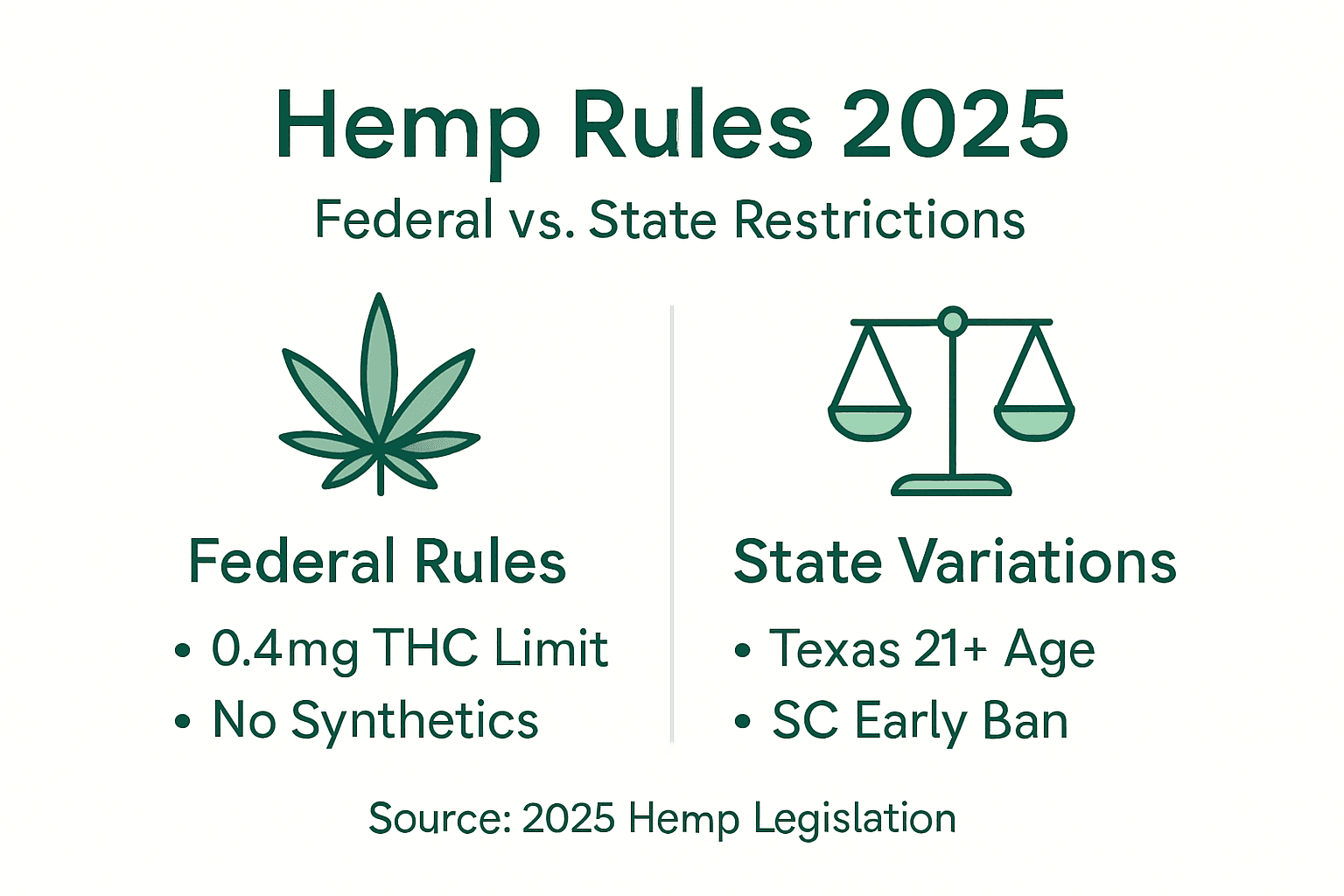
Enforcement of these restrictions presents real complications that benefit consumers in some ways and create uncertainty in others. Federal enforcement coordination will involve the FDA and DEA working across jurisdictional boundaries, but actual enforcement will likely prioritize large-scale violations and those involving clear public health concerns rather than individual consumer purchases. Resource constraints mean the federal government cannot realistically raid every retail location or arrest every consumer holding prohibited products. This creates a gray zone where enforcement focuses on manufacturers and distributors rather than end users. Litigation and civil enforcement may serve as deterrents for businesses considering non-compliance. However, this uneven enforcement landscape also means different states will experience enforcement differently based on local priorities and federal resource allocation.
The state-by-state variation adds another layer of complexity. Some states like South Carolina are aligning their policies with federal restrictions, creating consistent rules. Others are challenging federal restrictions or implementing their own frameworks that conflict with federal law. This creates situations where a product legal in one state becomes illegal in another, and both states are illegal under federal law. The practical reality is that enforcement of hemp prohibitions remains complex due to jurisdictional overlaps and state-level hemp laws, meaning the transition period will involve uncertainty for consumers and businesses alike. If you currently purchase hemp products, the safest approach is to gradually shift toward products that clearly fall within the 0.4 mg per container limit well before November 2026. Waiting until the enforcement deadline approaches risks finding your preferred products disappear from shelves or retailers suddenly unable to restock.
Pro tip: Before November 2026, identify which of your current hemp products will remain legal under the 0.4 mg total THC limit and establish relationships with retailers who are actively reformulating their inventory to ensure you have compliant options available.
Risks for Buyers and Businesses in 2025
The stakes are real for both consumers and companies navigating the 2025 hemp landscape. For businesses, the risks are existential. Hemp manufacturers and retailers face a one-year window to reformulate entire product lines, rebrand, and establish new compliance protocols. Those unable to adapt quickly face legal penalties, product seizures, and loss of banking access. Many banks and payment processors are already withdrawing services from hemp businesses due to regulatory uncertainty, leaving companies unable to process transactions or access capital. The financial pressure is intense. Companies that invested heavily in delta-8, delta-10, or THCA products now hold inventory that becomes worthless in November 2026. Some businesses will shut down entirely rather than invest in reformulation. This industry-wide contraction threatens jobs across cultivation, manufacturing, distribution, and retail sectors. The hemp market that thrived just months ago is being systematically dismantled by federal policy.
For consumers, the risks manifest differently but are equally concerning. Product scarcity and potential black market growth represent major risks as legal avenues for hemp-derived intoxicants close. As compliant products become harder to find and prices potentially increase, some consumers will turn to unregulated or unsafe alternatives. Black market products carry obvious dangers including contamination, mislabeling, and unknown potency. You lose the consumer protections that regulated markets provide like third-party testing and quality assurance. Even worse, purchasing non-compliant products unknowingly exposes you to legal risk if enforcement priorities shift toward consumers rather than retailers. The legal landscape is fluid and unpredictable, meaning the protections you have today could vanish tomorrow. If you currently rely on hemp-derived products for wellness or recreational purposes, the transition period creates genuine uncertainty about product availability and safety.
Banking complications add another layer of risk that often goes unnoticed. As federal regulations tighten, financial institutions are recategorizing hemp businesses as high-risk and withdrawing services. This creates a cascade of problems: businesses cannot process payments, cannot secure loans for reformulation, and cannot maintain normal operations. Some legitimate hemp companies are being forced into situations where they must choose between operating outside the formal financial system or closing entirely. For consumers, this means retailers may disappear suddenly without warning. Established companies you trust could vanish from the market not because they violated laws but because they cannot access banking services. The practical reality is that the hemp industry is contracting rapidly, and the safest approach is to recognize that products you purchase today may not be available in six months. Stock up prudently on compliant products, identify alternative wellness options, and prepare for significant market shifts.
This table summarizes current risks for businesses and consumers in the evolving hemp market:
| Stakeholder | Main Regulatory Risk | Financial Impact | Product Access Risk |
|---|---|---|---|
| Manufacturers | Mandatory reformulation | Potential loss of banking | Inventory may become illegal |
| Retailers | Sudden product bans | Shrinking legal product range | Forced to exit market |
| Consumers | Legal uncertainty | Price increases, reduced supply | Risk of buying unsafe items |
Pro tip: Document which hemp products you currently use and research compliant alternatives now, then establish direct relationships with retailers to understand their compliance timelines and product reformulation plans before November 2026.
Navigate Hemp Legality Changes Confidently with 23State
The evolving hemp laws in 2025, especially in Texas and South Carolina, bring new challenges for consumers seeking compliant and high-quality hemp-derived products. With the stricter total THC limits and state-specific regulations, it is essential to stay informed and choose products that meet legal requirements today and beyond. Understanding terms like “total THC content,” “synthetic cannabinoids,” and age restrictions can help you avoid costly surprises and maintain access to premium hemp wellness options.
Explore our carefully curated selection of hemp-infused edibles and wellness products crafted to comply with the latest federal and state regulations. At 23State.com, we prioritize transparent product testing and regulatory compliance so you can enjoy your favorite lifestyle and recreational hemp items with confidence. Shop now to stock up on compliant products and benefit from exclusive discounts and free shipping offers. Stay ahead of the regulatory curve by visiting 23State.com today and secure your access to trusted hemp solutions.
Frequently Asked Questions
What is the new THC limit for hemp-derived products as of 2026?
The new limit for hemp-derived products is 0.4 mg of total THC per container, as defined by the 2025 federal regulations that take effect in November 2026.
How will the federal changes impact the availability of hemp-derived products?
Many current hemp-derived products, especially those containing delta-8 and delta-10 THC, will become illegal if they exceed the new THC limits. This may lead to reduced availability as manufacturers adapt to comply with the new regulations.
What should consumers look for when purchasing hemp products in light of the 2025 changes?
Consumers should verify third-party lab testing results for total THC content, ensuring it is below 0.4 mg per container, and inquire about any planned reformulations that comply with upcoming regulations.
Are there specific age restrictions for purchasing hemp products?
Yes, both Texas and South Carolina have implemented age restrictions, allowing only individuals aged 21 and older to purchase hemp-derived products, similar to alcohol regulations.